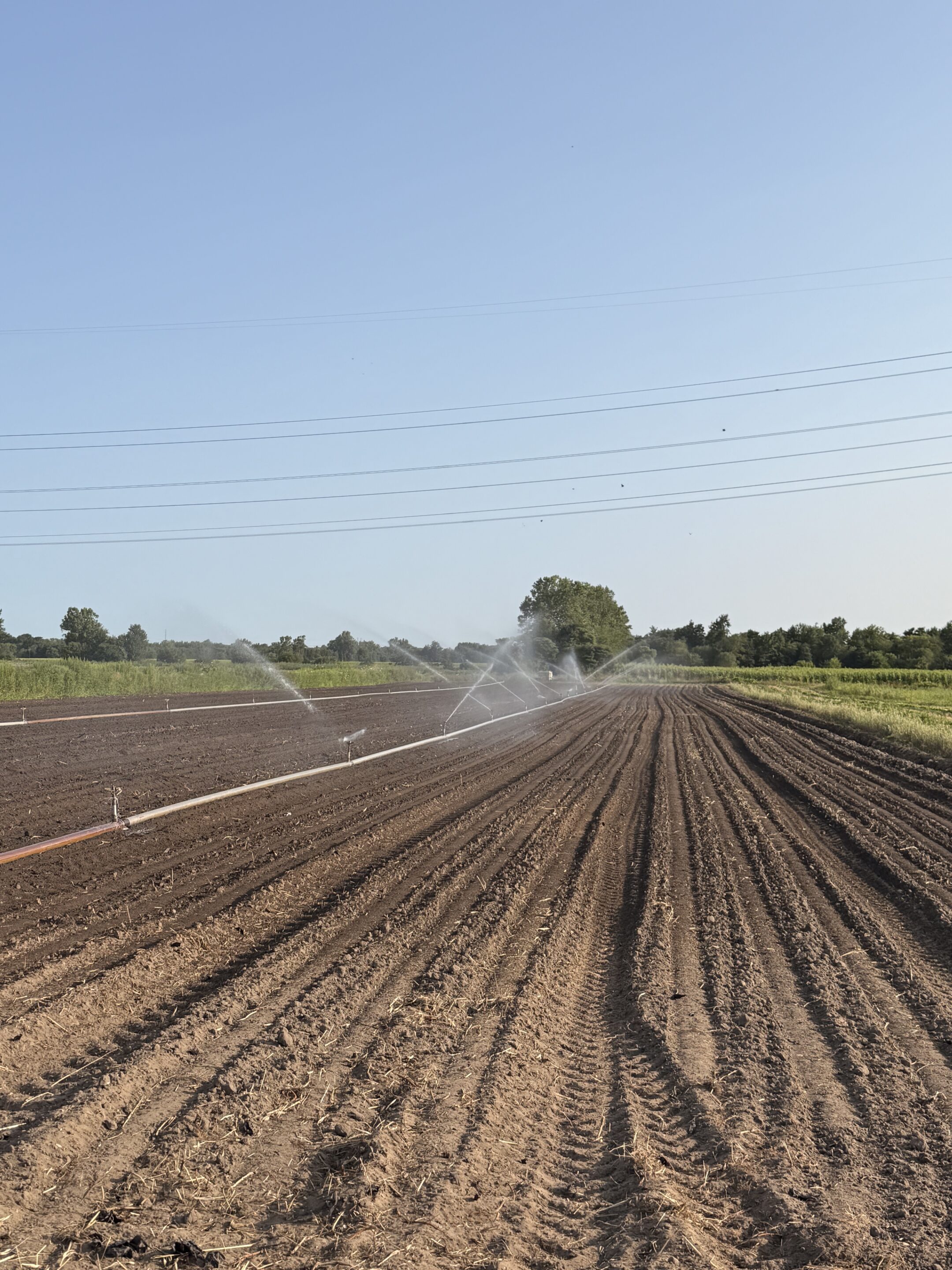
Alot of time has been spent moving pipe, checking lines, watching the sky. Irrigation has become a full-time job on top of everything else.
All of our irrigation runs off our own wells, and we’re lucky to have three different systems, each one earning its keep depending on what’s growing:
The traveler covers our larger row crop fields like carrots, sweet corn, and potatoes — it’s a big gun on wheels that slowly makes its way across a field, laying down water over a wide area. Good for covering ground fast when a field needs a soak.
Overhead irrigation also covers those same larger crops — carrots, sweet corn, and potatoes. This system uses pipes that we physically move from field to field, so we can direct coverage exactly where it’s needed most on any given day.
Drip irrigation is the most targeted of the three — tiny lines that deliver water right to the base of the plant, slowly and precisely. We rely on this for our greens, pickles, zucchini, summer squash, cucumbers, celery, peppers, and tomatoes, keeping them steadily watered without wasting a drop.
Even with all three systems running, we can’t give every field everything it needs right now. There’s just not enough water — or enough hours in the day — to do that. So,we make choices. Newly planted crops get top priority, since young roots are the most vulnerable and the least able to survive a dry stretch. Established plants with deeper roots can hold on a little longer while we get to the fields that need us most.
It’s a balancing act, and some days it feels like we’re just trying to keep up. But this is farming — you plan for the season you hope for, and you adapt to the one you get.